City of South Lake Tahoe
Greenhouse Gas Inventory

Picture of Meredith Anderson

Meredith Anderson

Project Manager

As part of our commitment to advancing climate action and energy resilience in the Sierra Nevada, Sierra Business Council offers greenhouse gas (GHG) emissions inventories to local jurisdictions in the region. SBC’s Climate & Energy team recently completed a GHG inventory update for the 2021 calendar year for the City of South Lake Tahoe (SLT). This included both a community-wide GHG inventory and a government operations GHG inventory. 

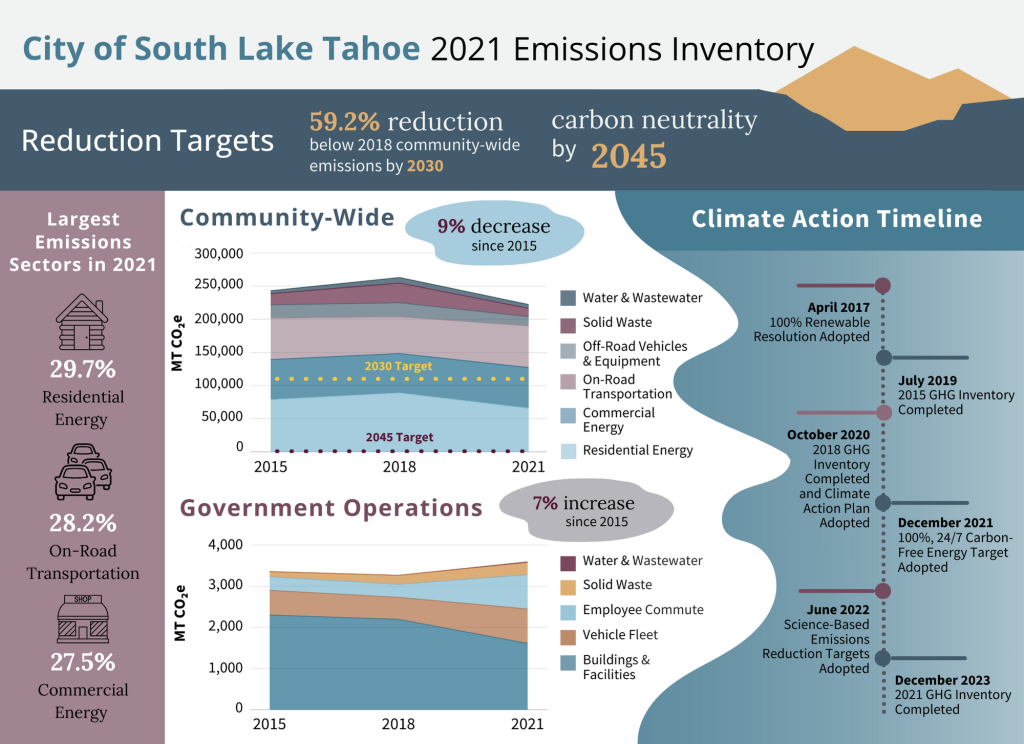
In 2017, SLT adopted Resolution 2017-26, establishing Renewable Energy and Carbon Emissions Reduction Goals. This committed SLT to reach the following emissions reduction goals: 50% below 2015 levels by 2030 and 80% below 2015 levels by 2040. In 2019, as a part of the climate action planning process, SLT conducted a baseline GHG inventory using data from 2015. This inventory served as the foundation for SLT’s first climate action plan (CAP), which was adopted unanimously in October 2020. The CAP outlines strategies and actions to reduce GHG emissions in SLT. In 2022, the 2030 goal from the 2017 resolution was updated with a new science-based target of 59% below 2018 emissions by 2030 and carbon neutrality by 2045. Using the information provided in this updated inventory, SLT will be able to track progress compared to previous inventories and prioritize strategies for implementation from the CAP.

The 2021 community-wide inventory update was broken into residential and commercial energy, on-road transportation, off-road vehicles and equipment, solid waste, and water and wastewater sectors. 

  • The energy sector includes emissions associated with electricity, natural gas, and any other fuels used for heating or cooling.
  • Transportation includes emissions from on-road vehicles making trips to, from, or within the city boundary.
  • Off-road vehicles and equipment includes aviation and boating, in addition to any other off-road equipment activities
  • Solid waste emissions come from methane released at the landfill, relative to the tons of waste generated within city boundaries. 
  • Water and wastewater includes any emissions from water supply or wastewater treatment processes. 


The government operations inventory estimates the emissions that result from all SLT activities and operations, including buildings and facilities, vehicle fleet, solid waste, employee commute, and water and wastewater. Emissions from government operations are accounted for within the community-wide inventory. However, as these are emissions that SLT has more control over, it is important to isolate and estimate the emissions that result from city operations

Community-Wide:

The top three contributors to GHG emissions in SLT were residential energy consumption at 30%, on-road transportation at 28%, and commercial energy consumption at 28%. These three sectors total over 85% of all city-wide emissions in 2021.

Total community-wide emissions decreased by approximately 8.5% between the 2015 baseline and 2021. Between these years, emissions decreased from residential energy (16%), off-road vehicles and equipment (30%), and solid waste (26%), while all other emissions sources increased. 

Government Operations:

The largest emissions-generating sector within city operations was from buildings and facilities which accounted for 44.9%. Vehicle fleet and employee commutes each contributed the next highest emissions, both at 23% of total government operation emissions. These three categories account for 91% of all city-produced emissions.

Total government operations emissions increased by 7.1% between the 2015 baseline and 2021. Between these years, emissions from buildings and facilities decreased by 30%, while all other emissions sources increased, including SLT’s vehicle fleet (40%), employee commuting (152%), and solid waste (136%). The water and wastewater sector was not included in previous GHG inventories, therefore no comparison can be drawn.

Read the full City of South Lake Tahoe Greenhouse Gas Inventory 2021 Update here. 

If you are interested in contracting Sierra Business Council to conduct a greenhouse gas inventory or energy/climate action plan, please click here to learn more about our services or email the team at climate.energy@sierrabusiness.org30

Read More Recent Blogs

October 2026 Update: Government Affairs

With the conclusion of the 2025-26 legislative session in September, SBC’s focus has shifted from advocating for Sierra Nevada bill and budget priorities to preparing for the 2027 session. As part of this work, SBC has been convening with partners to reflect on lessons learned from the legislative year and discuss regional priorities for the upcoming session at events across the state, including:
The Outdoors for All Field Convening in Plumas County to learn more about Outdoors for All in the region, weigh in on state initiatives, and connect with regional partners.
The Nature-Based Solutions Forests and Mountain Meadows Summit in Tahoe City, hosted by California Natural Resources Agency, Sierra Nevada Conservancy, California Tahoe Conservancy, and The Nature Conservancy. SBC Director of Government and Community Affairs Emily Blackmer moderated a panel discussion on Innovative Finance for Nature-Based Solutions.
The Sierra to California All Lands Enhancement (SCALE) conference, hosted by Sierra Institute, where Emily spoke on the panel State Leadership in Action: California Natural Resource Policy and Collaborative Landscape Stewardship.
The California Wildfire & Forest Resilience Task Force North Coast Regional Meeting to hear quarterly updates on the Task Force’s work and connect with partners.
The Nevada County Sustainability Summit: Rural Prosperity in a Changing Climate to learn about climate action in the area.
The California Economic Summit, where SBC president Steve Frisch spoke at two sessions: The Bioeconomy: A Possible Win-Win-Win for California and Wildfire Resilience: A Strategic Action Plan for the Next Administration.
SBC has also been closely monitoring the November midterm elections and what decisions on the ballot will mean for the Sierra Nevada. Read more here to learn our perspective on several ballot measures with implications for housing, local government capacity, environmental review, climate resilience, and the ability of Sierra communities to shape their own future.