

Two SNEW services that are often requested by Sierra Nevada public agencies are energy benchmarking (sometimes including AB 802 reporting for buildings over 50,000 square feet) and greenhouse gas (GHG) emissions inventories. By receiving one of these reports, agencies can better understand their historic energy use patterns and resulting impacts on utility bill costs and GHG emissions. So why is this information important, and why is California interested in collecting even more data on building performance?
Nationally, many jurisdictions and building operators have been benchmarking building energy use and GHG emissions for decades. It turns out, by tracking the key factors in energy consumption and environmental impact, realistic reduction actions can be achieved, resulting in lower energy bills, cleaner air, and higher-quality building stock. An EPA Energy Star Portfolio Manager study of 35,000 benchmarked buildings found that those who benchmark energy use on a regular basis “tend to reduce their energy consumption by 2.4 percent per year, on average.” Even though benchmarking itself may help reduce energy use, the State of California is now considering building on its AB 802 benchmarking efforts to produce even larger savings and GHG reductions.
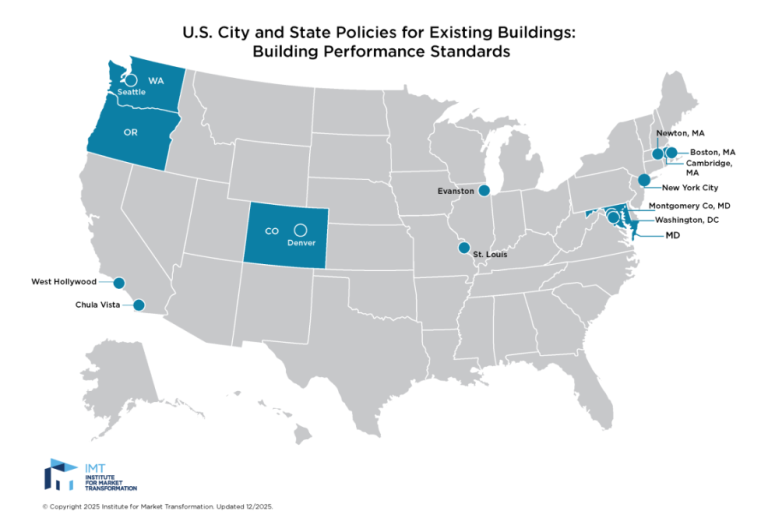
In 2023, the California Legislature passed Senate Bill 48: Building Energy Savings Act. This legislation aims to build on AB 802 benchmarking to reduce energy consumption and GHG emissions in commercial (including public) and multi-family buildings greater than 50,000 square feet, which may be done by introducing Building Performance Standards statewide. Building Performance Standards are a tool used by many jurisdictions across the country (see map below) to reduce energy use and environmental impact resulting from the largest buildings within their regions. Recently, the California Energy Commission released a draft strategy for using benchmarking data to lower energy use and GHG emissions. The strategy depends on a tiered reduction in energy use intensity and GHG emissions over time in five-year increments, with a target of 2045 to meet long-term performance goals, still to be defined.
If your agency has a building or buildings that have required AB 802 reporting in the past, this will be something to keep an eye out for. The SNEW team can help by completing no-cost energy benchmarking reports, GHG Inventories, or connecting public agencies in the Sierra Nevada with energy and emissions saving programs and incentives. This can help agencies get ahead of the curve so that when Building Performance Standards are officially introduced, there will be less of a burden and time crunch to meet them. By planning ahead, expenses can be spaced out and benefits, including lower energy bills, can be realized sooner.
If your agency has a building or multiple buildings exceeding 50,000 square feet and are interested in better understanding how to reduce energy use and GHG emissions, contact the SNEW team at snew@sierrabusiness.org to learn more about available support services.
Read More Recent Blogs

Convening the Sierra – Fall 2026
Join SBC at these Upcoming Events Across the Region

2026 Legislative Session: What It Means for Wildfire & Climate Resilience
California’s 2026-27 legislative session wrapped up September 1 after a turbulent final week of negotiations over wildfire policy, funding, and the state budget. While a last-minute proposal on wildfire liability ultimately stalled, the Legislature did restore and increase funding for climate resilience through Proposition 4 and the Greenhouse Gas Reduction Fund (GGRF)—a meaningful outcome for Sierra communities amid a challenging state budget year.
The final plan includes $329.5 million for wildfire and forest resilience through Prop 4 and $118 million for wildfire prevention through GGRF. While these investments are an improvement over the June budget, wildfire resilience funding remains near historic lows, with no clear plan for sustained investment in future years.
Read more about the final budget, Prop 4 and GGRF allocations, and what’s next for wildfire and climate resilience in the Sierra.
Prop 45 – Oppose
Prop. 45 would make significant changes to California’s environmental review and permitting processes for certain projects.
SBC supports thoughtful efforts to streamline permitting for projects that address urgent needs, including housing and wildfire resilience. However, we believe the changes proposed by Prop. 45 are too broad and could reduce important environmental protections, public participation, and local decision-making while placing additional demands on already-limited local government capacity.